Deep Time, Short Notice
For me, the most intoxicating aspect of working with native plants is their connectedness. They go beyond decoration (although many are stunning) and reach back into deep time, displaying evolutionary relationships millions of years in the making.
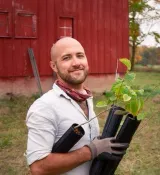
I run the Native Plants department at a small garden center on Chicago's West Side. Our corner of the city is still mostly industrial buildings and asphalt, so our shop yard filled with local-ecotype native plants serves as a welcome pitstop (Pollinator Pathway-style) for insects on their way to wilder locales. The railroad right-of-way nearby displays a smattering of native wildflowers growing alongside the weeds, and I like to think of it as an artery moving pollinators to and from our shop, the same way the train tracks move people.
In July and August, the bee activity at the shop can be immense. Part of this is due to the honeybees venturing from the urban farm next door, and seeing them gives me mixed feelings: honeybees aren't part of our native ecosystems. They arrived from Europe in the 1600s, are more like livestock than wildlife in North America, and are not in any real danger of dying out (countless SAVE THE BEES campaigns displaying glossy honeybee photos notwithstanding). Ecologically, they aren't the heroes their PR teams would have you believe: where hive density is high, honeybee colonies can outcompete native bees and even introduce pathogens. While honeybees are an important part of modern food systems (honey is hard to beat), the roughly 500 native bee species in Illinois are often overlooked in a world where native pollinator numbers are declining rapidly.
Luckily, our native plants serve everyone, including four types of native bees that were especially busy at the shop last month. What interests me is how differently each species depends on native plants: as food, as building material, and as homes themselves.
Bombus griseocollis
Brown-belted bumblebee
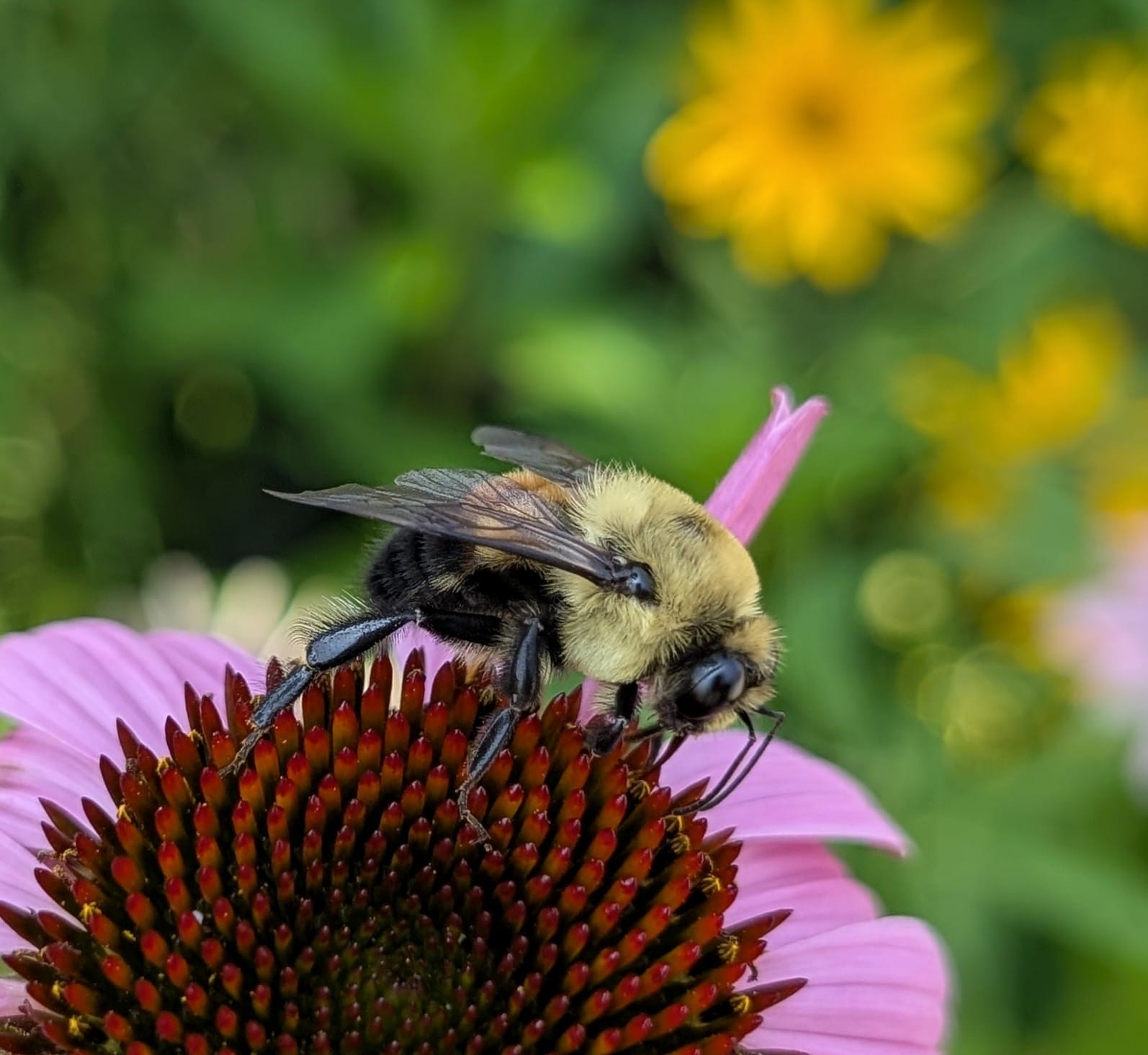
Like honeybees (and unlike many other native bees), bumblebees generally live in societies. Bumblebee queens emerge from hibernation in spring, find an abandoned rodent burrow or dense clump of grass, and start a small colony that has to feed itself continuously until frost. These queens cannot stockpile the way a honeybee hive does; bumblebees keep only a few days of nectar on hand. They need blooms in April, blooms in September, and every month in between, all within a short flight of a hole in the ground that remains undisturbed. A brown-belted bumblebee in July is evidence that spring resources were there when she needed them.
Melissodes bimaculatus
Two-spotted longhorn bee
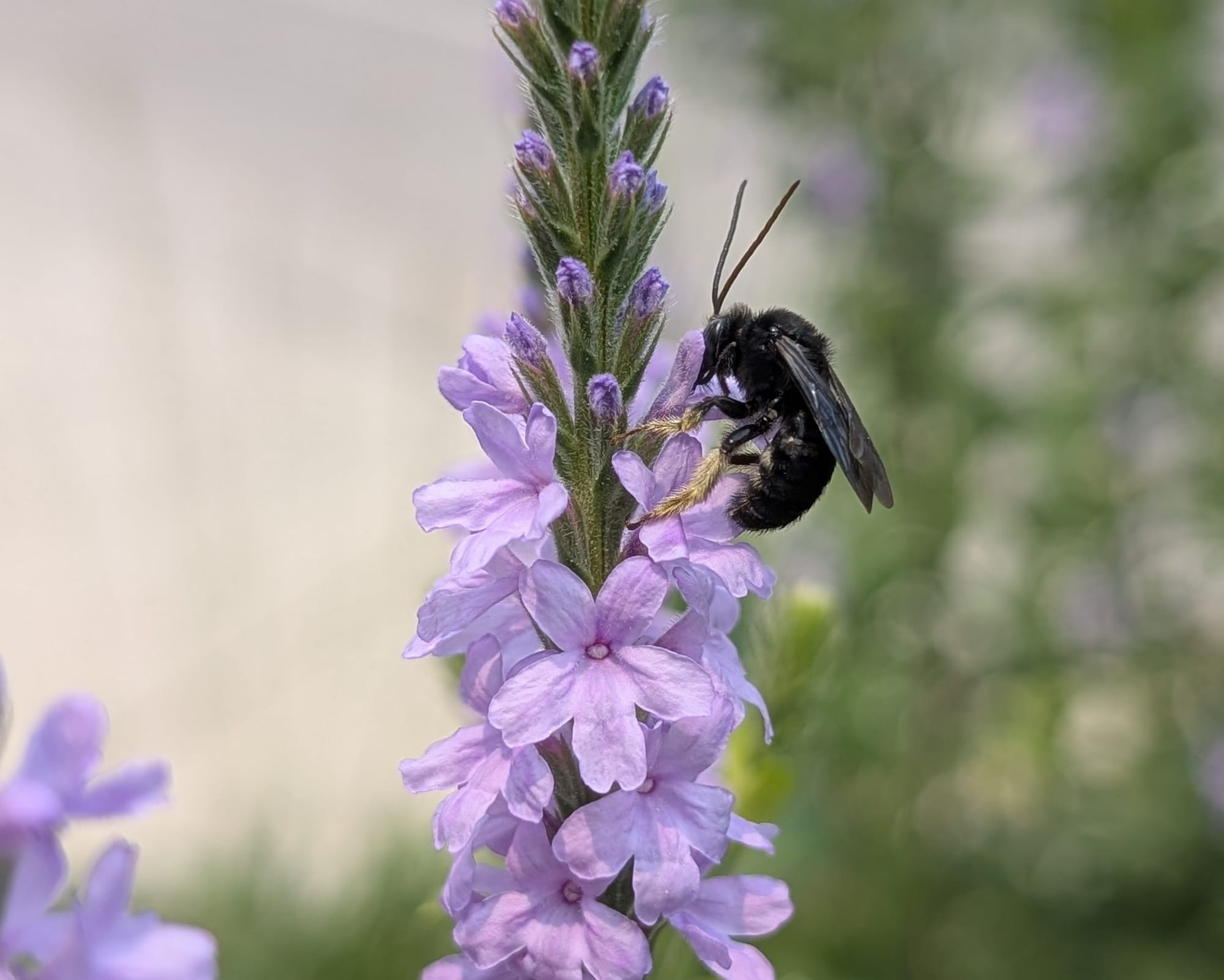
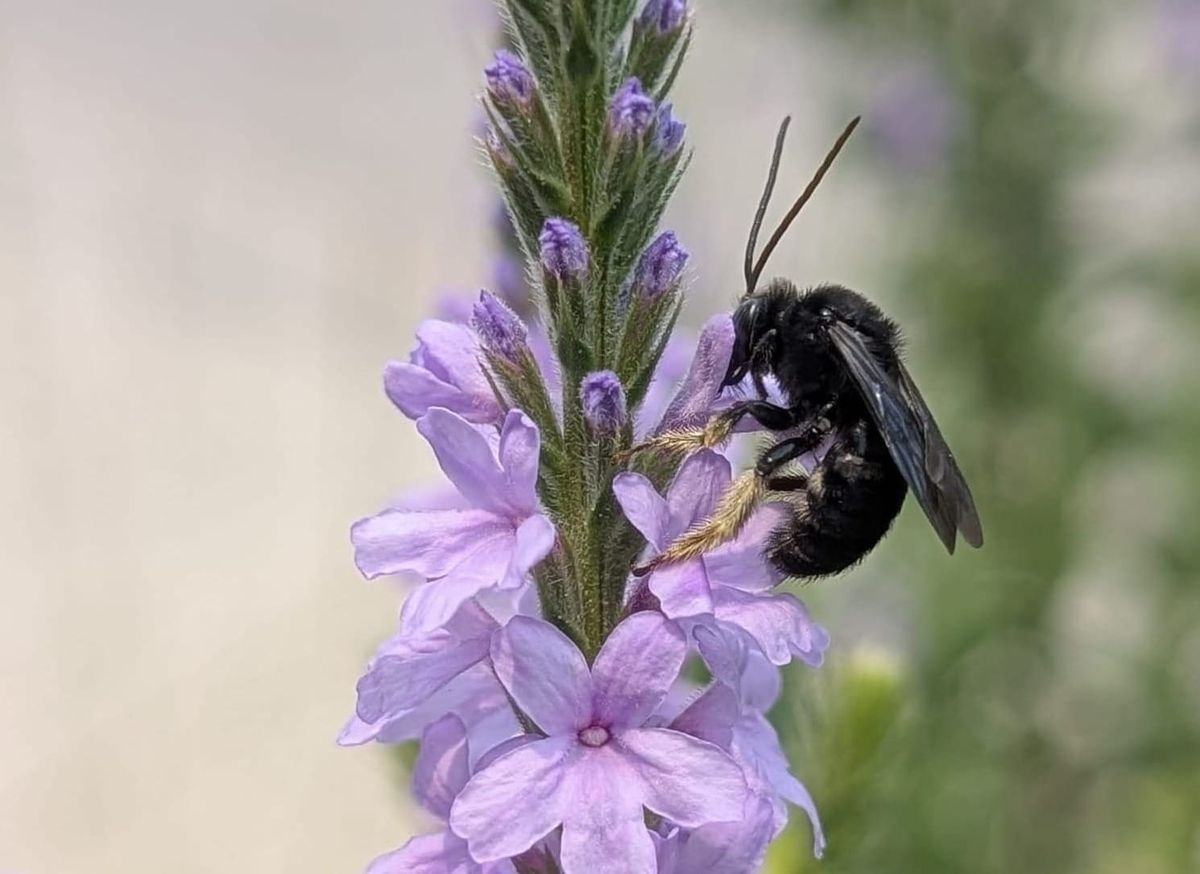
To contrast the colony lifestyle, many native bees are "solitary" and function as single mothers. Female longhorns have short, stubby antennae (unlike the male pictured above, providing the "longhorn" namesake) and are often seen foraging with an unshakable focus. The stakes are real: longhorns have one generation per year, emerging in midsummer, with each mother digging and provisioning her own nest in the ground. It's all about timing, and if weather or bloom times slip out of alignment, there is no second brood to make up the difference. Males never go back to the nest, and live their short lives out in the elements; at dusk they clamp their jaws onto a flower stem and sleep there, sometimes several to a stalk.
Megachile sp.
Leafcutter bee
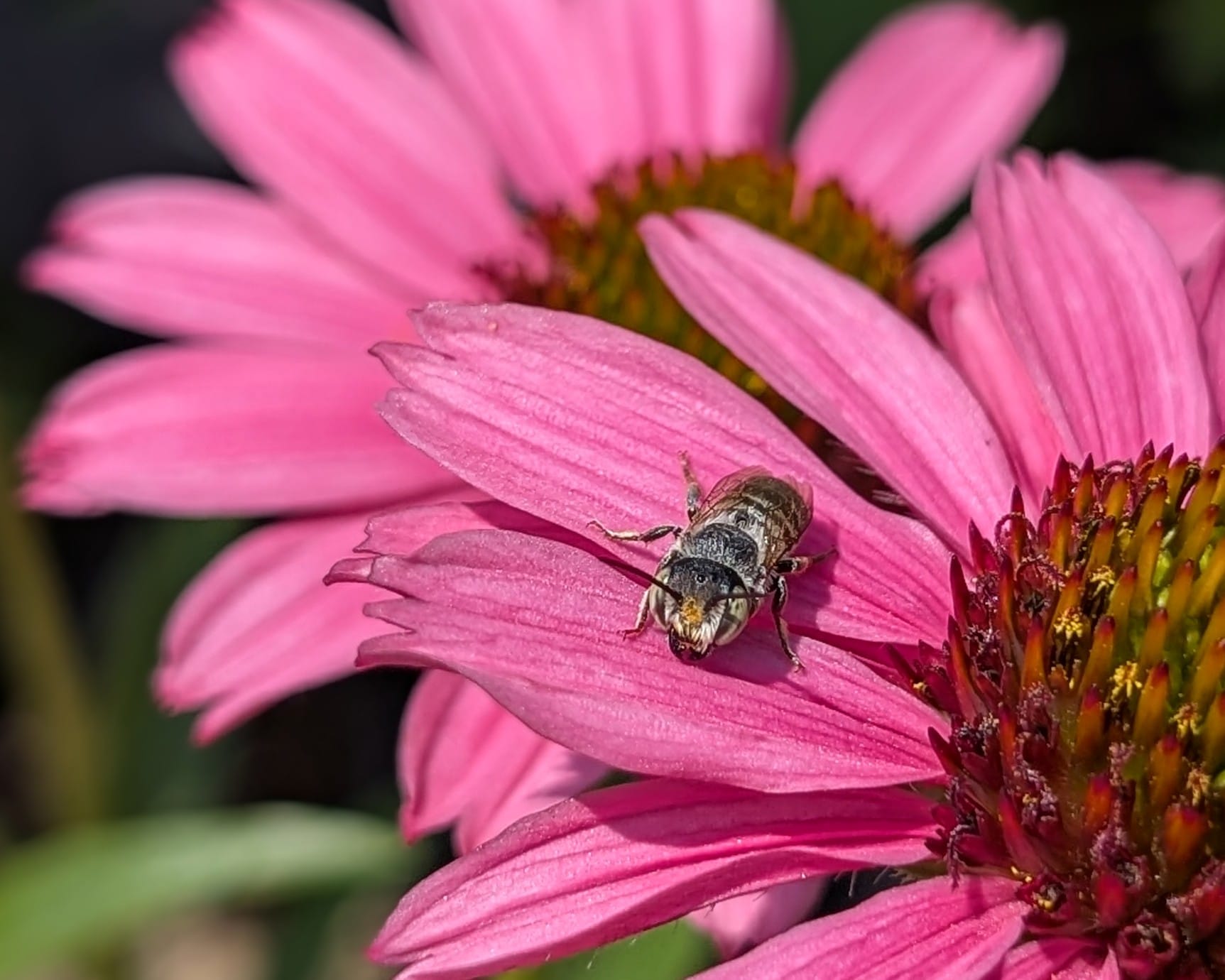
Leafcutters carry pollen on a brush of hairs under the abdomen, so you won't see their legs loaded with yellow like other bees. She is a builder, and lines her brood cells with leaf tissue that she cuts herself, in neat discs, from suitable plants growing nearby: redbud, ash and roses commonly display these round "chomps". Gardeners often see the circles as a sign of pests, but they actually indicate that the garden is being integrated into the living world. This also makes the question of avoiding pesticides at the shop less abstract: she is handling this plant tissue directly and using it as nursery material to wrap around her young.
Hylaeus sp.
Masked bee
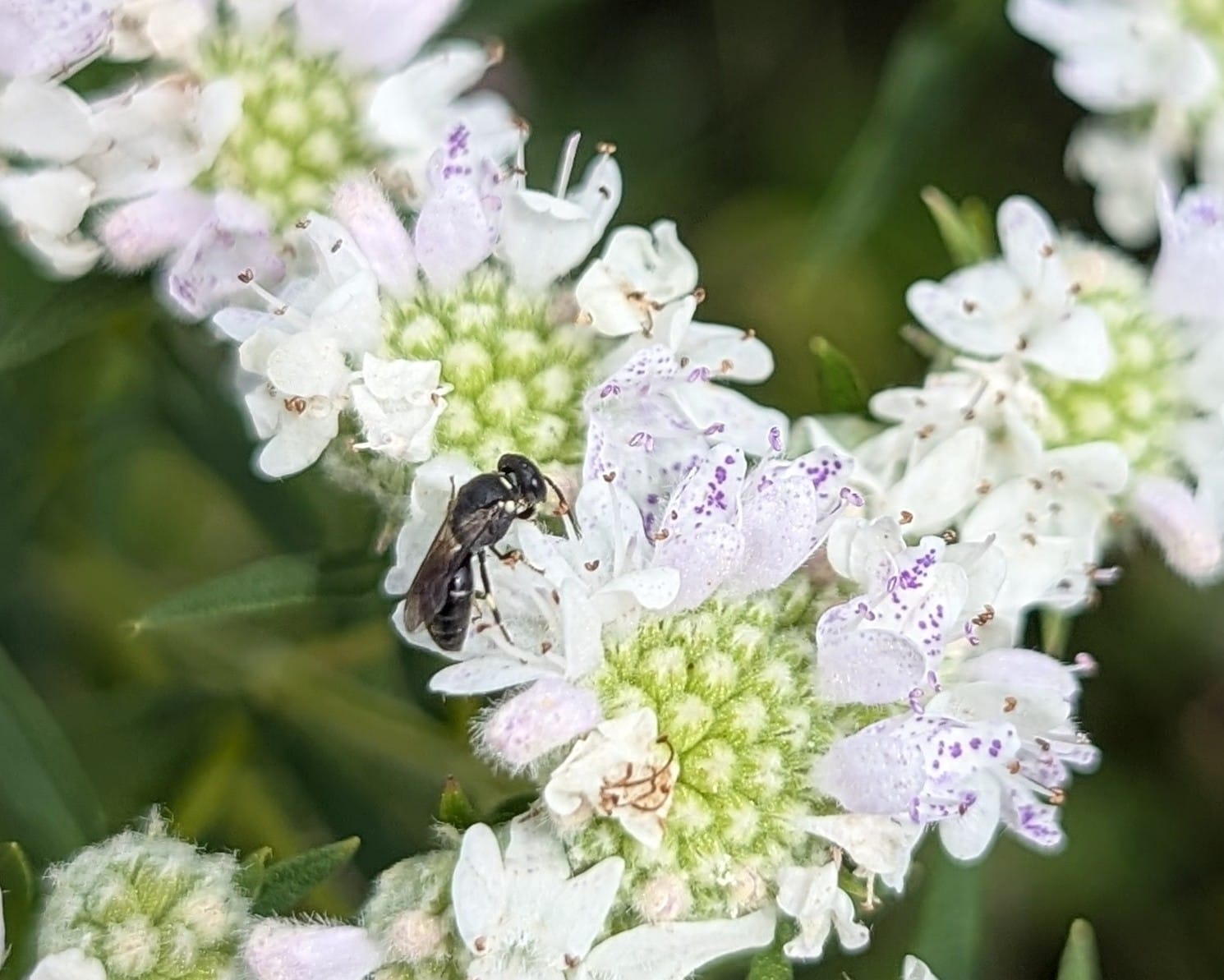
A mere 6 millimeters, nearly hairless, and so tiny and wasp-like that most people never clock her as a bee at all. A masked bee mother carries no pollen outside her body: she swallows it, flies home, and brings it back up in the cell. She gathers no building materials either, waterproofing the nest with a cellophane-like secretion that she produces herself. One thing she cannot manufacture is the cavity: she often nests in pithy stems (mountainmint, beebalm, and many others) where something else has already made an opening. To help her out, trim your dead stems to knee-high in winter: she'll move into the stubble by spring. Removing that year-old stubble during spring cleanup is what disrupts her lifecycle, so it's important to let the remaining stems decay naturally.
Ultimately, planting for "blooms all season" is good advice, but this is only one piece of the puzzle. More than just nectar, these native bees need something closer to a whole ecosystem (established plantings with density, stems, sticks, and debris), which raises questions about what a “cared-for space” should actually look like. Mow-and-blow landscaping, aggressive spring cleanup, a garden 'refresh' every three years (the design got “tired”, the property changed hands...) are the practices of constant disturbance that never let a planting mature into a community. A bumblebee queen needs a nest left alone between October and April. A masked bee needs a standing stem available when she emerges. These are not large requests, but they are measured in years; a challenge for a culture of immediate results. This isn't an argument against all disturbance (our prairies require periodic fire, for example), but it is an argument about habits and restraint in the garden.
I will keep watching these bees through the season as they go about their work, and will maintain the areas under my stewardship in ways that give them a chance. Nothing is permanent, but these bees don't require permanence: they require patience and consistency, one year at a time. Relationships that took millions of years to build now hinge on how we decide to garden. That is something we can all manage, and it just might be enough.